
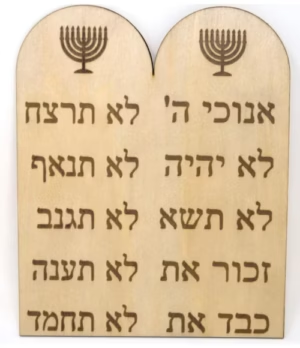
The presentation of the Ten Commandments in Parashat Va’etchanan (Deuteronomy 5:6–18) constitutes one of the most significant textual variants in the Pentateuch. While the Decalogue first appears in the Sinai narrative of Parashat Yitro (Exodus 20:1–14), Moses’ retelling in Deuteronomy is not a mere repetition. It introduces substantive differences in wording and rationale that reflect the distinct theological and historical context of the Israelites on the eve of entering the Land. Furthermore, a close textual analysis reveals that the traditional “Ten” Commandments are a conceptual framework rather than a literal sentence count, serving as a hermeneutic key to the entire Torah.
Contextual Divergence: Yitro vs. Va’etchanan
The two accounts of the Decalogue are often treated as identical, yet a comparative reading highlights deliberate editorial choices that shift the theological emphasis from the universal to the particular.
1. The Rationale for Shabbat: Cosmic vs. Historical
The most profound divergence concerns the Fourth Commandment. In Exodus 20:11, the commandment to “Remember” (Zachor) the Sabbath is anchored in cosmology: “For in six days the Lord made heaven and earth.” Here, Shabbat is a universal commemoration of Creation, binding humanity to the rhythm of the cosmos.
Conversely, Deuteronomy 5:15 commands Israel to “Keep” (Shamor) the Sabbath based on history: “Remember that you were a slave in the land of Egypt… therefore the Lord your God commanded you to keep the Sabbath day.” In Va’etchanan, Shabbat becomes a specific sign of the covenant, a weekly reminder of liberation from bondage. This shift transforms the day of rest from a general theological concept into a specific social justice imperative, ensuring that the memory of slavery informs the treatment of servants and strangers.
2. Honoring Parents: The Weight of Authority
In the Deuteronomic version, the commandment to honor parents (5:16) is expanded. Moses adds the phrase “as the Lord your God has commanded you” (ka’asher tzivcha). This insertion, absent in Exodus, serves to reinforce the authority of the commandment at a moment when the older generation is passing, and the new generation must reaffirm the covenant. Additionally, the promised reward is lengthened to include “and that it may go well with you,” suggesting that societal stability is contingent upon the preservation of familial hierarchy and respect.
3. Coveting: The Economics of the Land
The final commandment regarding coveting (5:18) exhibits a subtle but significant addition. While Exodus lists a neighbor’s house, wife, and livestock, Deuteronomy inserts “field” (sadeh) into the list. This addition is contextually specific to the audience of Deuteronomy: a generation preparing to inherit the Land of Israel. By including the field, the text addresses the specific economic temptation of land accumulation, warning against the greed that could lead to the dispossession of others and the erosion of the tribal allotment system.
The Numerology of Revelation: Is “Ten” Literal?
A literal reading of the Hebrew text in both Exodus and Deuteronomy presents a challenge to the traditional count of ten. The text is divided into 13 distinct sentences (or pesukim), and if parsed by distinct prohibitions and positive commands, one can identify 12 or more discrete injunctions.
The discrepancy arises from the difference between the textual units and the traditional categorization. The Talmudic tradition (Makkot 23b–24a) and subsequent codifiers group these 13 sentences into ten dibrot (statements) through specific hermeneutic moves:
- The First Two as One: The prohibitions against “other gods” and “graven images” are combined into a single commandment (the 2nd) to maintain the count of ten.
- Coveting as One: The various forms of coveting (house, wife, field, etc.) are aggregated into a single final commandment (the 10th).
Other traditions, such as certain Christian enumerations, split the prohibition of idols from the prohibition of other gods (making them commandments 1 and 2) but then combine the coveting of a wife with the coveting of property to arrive at ten. Thus, the number “Ten” is not a simple arithmetic fact but a theological construct. It represents a complete set (asara, ten, often signifies completeness in Hebrew thought) designed for mnemonic and pedagogical utility.
The Decalogue as a Microcosm of Torah
The significance of the number ten extends beyond mere categorization. Classical Jewish thought posits that the Decalogue is not merely a list of ten rules, but a compressed summary of the entire Torah. The sages note that the Ten Commandments contain 620 letters, corresponding to the 613 commandments of the Torah plus the seven rabbinic enactments (or the seven Noahide laws, depending on the interpretation).
From this perspective, each of the ten statements functions as a header or category (kotel) under which hundreds of specific laws are subsumed.
- “I am the Lord your God” encompasses all positive commandments regarding faith and knowledge of God.
- “You shall not murder” generates the vast legal corpus regarding the sanctity of life, courts, and liability.
- “Honor your father and mother” expands into the detailed laws of kibud av va’em.
In this view, the “Ten” are the ten sefirot or channels through which the divine will flows into the 613 specific mitzvot. They are the general principles (klal) from which the specific details (prat) are derived.
Conclusion: The Infinite in the Finite
The dual presentation of the Decalogue in Yitro and Va’etchanan, along with the tension between the textual count and the traditional number, offers a profound lesson on the nature of Torah study. The text is designed to be concise on the surface yet infinite in its depth.
The variations between Exodus and Deuteronomy teach us that revelation is not a static event frozen at Sinai, but a dynamic process that must be reinterpreted for each generation—shifting from the theology of Creation to the ethics of Liberation, and from the wilderness to the complexities of life in the Land. Similarly, the “Ten” Commandments remind us that the Torah is not a simple checklist of rules, but a holistic system where ten concepts expand to encompass the entirety of human experience and divine service. As we engage with Parashat Va’etchanan, we are invited to look beyond the number ten and discover the 613 dimensions of holiness hidden within.


